
Categories
Blogs

Still Posting Static Content? Here’s Why Interactive Social Media Content Is Winning in 2026

For many years, brands have been relying heavily on static posts like single images, generic captions, and occasional promotional graphics. While this approach once provided reasonable engagement, the social media landscape in 2026 looks dramatically different. 

Today’s users are scrolling faster, expecting personalization, and demanding experiences rather than passive consumption. Attention spans are shorter, algorithms are smarter, and competition for visibility is intense. As a result, static-only social media content is no longer enough to capture interest or drive meaningful engagement. 

This shift has been paving the way for interactive social media content, which encourages participation, creates two-way communication, and provides valuable insights into user behavior. In 2026, brands that are adopting interactive formats are seeing significantly higher engagement, stronger customer relationships, and better conversion outcomes. In 2026, interactive social media content is not just increasing engagement; it is significantly boosting reach, saves, and conversion rates across platforms.

What Is Social Media Content in 2026?

Modern social media content can go far beyond simple visuals and captions, especially with the rise of AI-driven content creation.

Static vs Interactive Content
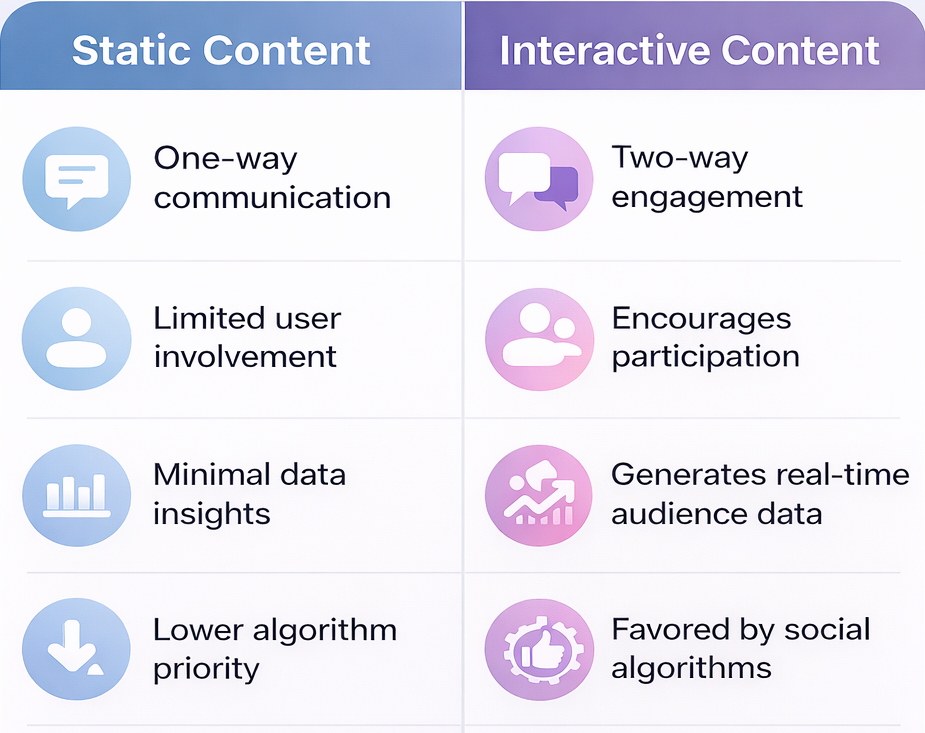
Examples of Interactive Social Media Content

In 2026, the most effective formats include:

  • Polls and quizzes on stories
  • Interactive sliders and reaction tools
  • Gamified social posts
  • AR filters and immersive effects
  • User-generated content campaigns
  • Interactive reels and shoppable videos
  • Stories with clickable CTAs such as “Swipe Up,” “Vote Now,” or “Shop Here.”
  • Short-form interactive video content like reels and TikTok-style formats

These formats transform audiences from passive viewers into active participants, which is exactly what social platforms reward today.

Why Interactive Social Media Content Is Winning in 2026

Interactive formats are not just trends; they provide measurable business results similar to well-planned social media campaigns.

  • Higher Engagement and Dwell Time: Interactive content can keep users involved and engaged for longer periods of time. If answering a poll or exploring an AR filter, users can spend more time interacting, which signals value to platform algorithms. 
  • Better Data Collection: Interactive formats provide valuable first-party data such as preferences, opinions, and behavioral patterns. This can help brands to refine their targeting and personalize future campaigns. 
  • Stronger Conversions and ROI: Engagement can naturally lead to higher conversion rates. Interactive content provides trust, encourages decision-making, and guides users through the customer journey more effectively. 
  • Algorithm Preference: Social media algorithms prioritize content that sparks engagement. Interactive posts can generate more likes, shares, comments, and clicks, which can increase organic reach. 
  • Increased Shareability and Virality: Participatory content is inherently more shareable. Users really love sharing quizzes, challenges, and interactive experiences with their networks, boosting brand visibility.  

More importantly, interactive formats transform social media from one-way broadcasting into two-way conversations, where users actively participate instead of passively consuming content.

Key Elements of a Strong Social Media Content Strategy

A successful social media content strategy in 2026 focuses on more than just posting regularly. It requires thoughtful planning and alignment with business goals. 

Key elements include:

  • Clear Business Objectives: Every piece of content should support a specific goal, be it brand awareness, lead generation, or customer retention. 
  • Platform-Specific Planning: Different platforms need different formats. Interactive reels may work well on Instagram, while polls and discussion threads perform better on LinkedIn. 
  • Consistent Brand Voice: Maintaining a recognizable brand tone and visual identity can build trust and also strengthen brand recall.
  • Balanced Content Mix: A strong strategy includes:
    • Educational content
    • Engagement-driven posts
    • Conversion-focused campaigns
  • Performance Tracking: Data analytics has a crucial role in tracking engagement rates, click-throughs, and audience behavior, which can help refine future content decisions. 

How to Build a Winning Social Media Content Plan

Creating a high-performing social media content plan needs a structured approach. Include a balanced mix of static posts, interactive content, and short-form video formats.

Step 1: Develop a Content Calendar

Plan posts in advance to maintain consistency while allowing flexibility for trending topics.

Step 2: Diversify Content Formats

Avoid relying on a single format. Include videos, polls, interactive stories, and user-generated content.

Step 3: Optimize Posting Frequency and Timing

Analyze audience activity patterns to determine the best times to publish content.

Step 4: Study Audience Behavior

Use analytics tools to understand what types of content your audience prefers and engages with most.

Step 5: Monitor Trends Continuously

Social media trends evolve rapidly. Staying updated ensures your strategy remains relevant.

Things to Consider When Creating Social Media Content

When developing modern social media content, brands should focus on quality, relevance, and engagement potential. Brands should also adapt content based on platform behavior, as audiences engage differently on Instagram, LinkedIn, TikTok, and Facebook.

  • Audience Intent: Understand why your audience follows your brand and customize content accordingly. 
  • Visual Storytelling: Compelling visuals, along with a strong narrative, can increase emotional connection. 
  • Clear Calls to Action: Encourage users to take a specific action, like participating in polls, exploring product links, etc. 
  • Consistency Without Fatigue: Maintain regular posting schedules without overwhelming your audience. 
  • Data-Driven Optimization: Continuously analyze performance metrics and adjust strategies accordingly. 
  • Promotion Budget Planning: Allocate resources for boosting high-performance content to maximize reach. 

Social Media Content Promotion: Posting Isn’t Enough

In 2026, organic reach alone cannot guarantee visibility. Effective social media content promotion is also essential. 

  • Limited Organic Reach

Algorithms prioritize paid and highly engaging content, making organic reach increasingly competitive. 

  • Boosting High-Performing Posts

Promoting posts that are already showing strong engagement can improve ROI and visibility. 

  • Paid and Organic Integration

Combining organic content strategies with paid promotions can make broader audience coverage. 

  • Retargeting Strategies

Using audience data for retargeting can help convert users who previously interacted with your content. 

How Moonbox Helps Brands Win on Social Media

What sets Moonbox apart is how it shapes smart social media strategies built for a world that moves quickly online. Instead of just sharing updates, they blend careful planning with fresh ideas to lift brands past routine uploads. Real connections form – not likes or shares – and those interactions quietly push results that matter most.

What stands out about Moonbox is how it builds strategies using real-time data. Instead of guessing, they rely on insights drawn from audience behavior and measurable results. These details shape content that fits exactly what a company needs right now. Often, that means boosting recognition, pulling in new leads, or strengthening existing customer ties.

What stands out about Moonbox is how it builds experiences around interaction first. Instead of focusing on static views, the team leans into formats where people join in – not just watch. Think puzzle-style campaigns that spark competition, or tales shaped by audience choices, for example. Even when creating shared moments online, the work leans toward depth over distance. Engagement becomes less about entry, more about staying involved.

Beyond that, Moonbox brings know-how tied to individual platforms – shaping content ways that fit how each social space works. Because it adapts, not copies, the method fits distinct habits in posting, scrolling, and sharing across apps. That fit tends to push results further in visibility, interaction, and outcome.

Right from the start – with planning and creative work – Moonbox handles every step needed to bring ideas to life. When it comes to putting things into action, sharing results, and then refining them, the company provides full coverage for social media content. Because of this depth, brands counting on solid performance turn to Moonbox as a reliable ally during today’s interactive content shift.

Adapt or Get Left Behind

The era of static-only posting has come to an end. In 2026, interactive experiences define successful social media content strategy and drive meaningful brand engagement. 

Brands that are invested in interactive formats can benefit from stronger relationships, valuable audience insights, and higher conversion rates. Those that fail to adapt risk losing visibility in an increasingly competitive digital landscape. 

The future of social media belongs to brands that create experiences — not just posts.

Ready to upgrade your social media content strategy? Talk to Moonbox about interactive social media content that converts.

FAQs

  • What is interactive social media content?

It is content that is designed to encourage active user participation rather than passive viewing. It can include formats like polls, quizzes, interactive stories, sliders, AR filters, gamified posts, and shoppable videos. This type of content can increase engagement, improve audience insight, and strengthen brand interaction. 

  • Why is interactive content important for social media in 2026?

Interactive content is crucial in 2026 because it can drive higher engagement, capture user attention for longer periods, and also provide valuable first-party data. Social media algorithms also prioritize content that generates interaction, making interactive posts more visible and effective than static ones. 

  • What are the examples of interactive social media content?

Common examples of interactive social media content include polls, quizzes, question stickers, interactive reels, AR filters, gamified contests, user-generated campaigns, and clickable stories. These can encourage users to participate and improve audience engagement. 

  • How can interactive content improve social media performance?

Social media performance can be increased by engagement rates, boosting dwell time, generating audience insights, and enhancing algorithm visibility. This can lead to stronger reach, better brand recall, and higher conversion potential. 

  • How can businesses create an effective social media content strategy?

Businesses can create effective social media content strategies by setting clearer goals, understanding audience behavior, using a mix of interactive and educational content, maintaining consistent branding, and regularly tracking performance metrics to optimize results. 
 

Categories
Blogs

Drive Revenue with Social Media Campaigns That Work

In the contemporary digital world, social media campaigns have transformed far beyond just being simple engagement tools; they are now a powerful statement for growth acceleration and revenue generators that provide measurable ROI. Even if you are a startup aiming to establish a stronger online presence or an enterprise looking to scale globally, using data-driven, creatively curated campaigns can pivot the way your brand connects, converts, and thrives. 

The most effective social media campaigns are not accidental; they are strategically designed ecosystems where creativity is incorporated into analytics, storytelling, and precision targeting, and emotional resonance with tangible results. When executed with effectiveness, either in-house or with the expertise of leading social media advertising agencies, these campaigns can attract attention and can also drive conversions, foster loyalty, and fuel sustainable business growth. 

Through this blog, we can explore the art and science behind building, executing, and optimizing social media campaigns, which can go beyond vanity metrics. You can discover how to develop a result-driven campaign strategy, enhance high-performance ad techniques, and understand that when partnering with a social media advertising agency like Moonbox, you can definitely elevate your ROI and brand presence to the next level. 

Why Social Media Campaigns Are Critical for Business Growth

With billions of active users across different platforms like Facebook, Instagram, TikTok, LinkedIn, and X (Twitter), social media is becoming an indispensable business marketing tool in this digital age. 

According to GaggleAMP, brands have been using employee advocacy in their social media campaigns, which has achieved up to 3x higher engagement compared to traditional brand posts. Additionally to that, Quso.ai has highlighted that businesses incorporating video marketing into their strategies have experienced 49% faster year-on-year revenue growth. 

These insights emphasize the power of a well-structured social media campaign, one that integrates authentic storytelling, user participation, and accelerates business growth in today’s competitive market. 

  • Brand Awareness and Reach

Social media will allow your businesses to reach specific audiences at scale. Every share, comment, and click will act as a mini touchpoint, enhancing visibility and brand recall. With a well-crafted social media ad campaign, you will be introducing your products and services to new demographics, from local shoppers to global markets. 

  • Lead Generation and Sales

Social platforms not only act as awareness drivers; they are powerful conversion engines. Tools like Facebook Lead Ads and LinkedIn Lead Gen Forms will enable businesses to collect qualified leads directly within the platforms. When integrated with the right CRM system, these ads nurture audiences easily through the funnel. 

  • Measurable ROI

When compared with traditional media, social media campaigns offer precise tracking. With metrics like impressions, clicks, CTR, and ROAS, business can calculate their marketing efficiency in real time. This can make sure every dollar contributes to tangible results. 

In competitive industries like e-commerce or SaaS, strategies, social media ads can be the differentiator between brand visibility and obscurity. 

Building a Strong Social Media Campaign Strategy

To have a successful social media campaign, you will need a well-structured strategy. A stronger social media campaign strategy can sync with broader business marketing goals, define clear objectives, and identify what success truly looks like. When thoughtfully executed, it can ensure your social media ad campaigns are not just there to gain likes and clicks, but they also drive measurable business growth. 


  • Define Clear Objectives

Always start with “why.” Determine if your campaign aims to generate sales, leads, drive website traffic, increase app installs, or enhance brand engagement. With clear objectives, you can share every other decision, from content type to platform choices and ad format. Think of it as a mapping of your campaign to specific outcomes, like: 

  • Awareness: To reach new audiences and increase visibility. 
  • Engagement: Encouraging interactions and conversions. 
  • Conversion: Driving purchases, sign-ups, or inquiries. 

Having measurable KPIs (click-through rates, engagement rates, conversion rates) can make sure your campaigns are successful and can be tracked and optimized over time. 

  • Audience & Persona Mapping

One of the important cornerstones of effective social media campaigns is to understand your audience. Develop a detailed persona that outlines demographics, interests, challenges, and online behaviors. This will help you in having a more accurate audience segmentation, which can segregate your audience into more relevant and personalized ads. 

According to a recent article, campaigns that are customized for targeted segments are seeing up to 70% higher engagement rates. Meanwhile, Sprinkr reports that predictive AI tools are now helping marketers to pinpoint which audience segments are most likely to convert, which can maximize ROI from every impression. 

  • Align SEO and Content Strategy

Integrate SEO into your content plan using target keywords in post captions, alt text, and landing pages. Also, make sure campaign landing pages are optimized for mobile speed and meta tags. Repurpose social media content into a blog post for SEO visibility. This fusion can ensure your social presence reinforces your organic ranking and vice versa. 

  • Channel Selection

One of the most essential things is to choose the right platform. Do not aim to be everywhere; you should focus on where your audience already spends most of their time. 

  • Instagram/TikTok: These social platforms are great for visual storytelling, influencer collaborations, and product launches. 
  • Facebook: This platform is ideal for a border reach and conversion-driven ads using precise interest-based targeting. 
  • Pinterest: Highly visual and discovery-based, driving consistent referral traffic for e-commerce and design brands.
  • Threads: Emerging as an authentic, conversational alternative to X (Twitter), ideal for brand-building and organic reach.
  • LinkedIn: This is a go-to for B2B campaigns, recruitment, and thought leadership. 
  • X (Twitter): It is the best for trending conventions, announcements, and real-time engagement. 

Strategic channel selection helps businesses maintain brand consistency while optimizing ad spend.

  • Crafting Creative Assets & Messaging

Your creative approach can make or break your campaign. Visuals and copy should sync with your brand identity, campaign objectives, and audience preferences. Using high-quality visuals, authentic videos, and concise messaging that will encourage clicks or conversions will be a good choice. 

To improve your creative performance, use A/B testing early on by experimenting with different formats, headlines, or visuals to see what resonates the most with your target audience. AI-driven creative tools can now generate caption variants, imagery, and templates based on audience insights, which can help brands deliver more customized and engaging content. 

  • Budget Planning & Scheduling

Your budget should be driven by both your objectives and audience reach. By allocating resources strategically, reserving higher spending for platforms that deliver the strongest returns will be a smart choice. 

Use automation features like AI-driven bidding, pacing, and real-time budget adjustments to maintain cost efficiency. Tools like Meta Ads Manager and Google Ads will optimize bids dynamically, by ensuring maximum impact without overspending. When budgeting, you should always keep aside a portion for testing, to evaluate what works before scaling campaigns for better ROI. 

To balance creativity with data is one of the pro tips for building a strong social media campaign. While stronger visuals and storytelling will attract more attention, analytics will ensure consistent optimization. A well-defined social media campaign strategy that is backed by AI insights, audience data, and clear objectives will always outperform guesswork, turning your social media ads into powerful business marketing engines. 

Execution: Running High-Impact Social Media Ads

Once your social media campaign strategy is defined, the execution stage is where the strategy is synchronized with creativity and results. The goal is to turn your marketing blueprint into an engaging, ROI-driven social media ad campaign that can capture attention and convert effectively. 

Ad Formats & Creativity

A winning social media advertising campaign will be powered by variety and creativity. Experiment with multiple ad formats to discover what works best for your audience. Use Carousel Ads or Collection Ads to showcase your multiple products or services in a single view; this will be perfect for e-commerce or multi-offer promotions. 

Video Ads will remain as one of the most engaging formats, which are ideal for storytelling and emotional connection. Interactive polls and quizzes will encourage active participation and increase engagement metrics. 

Dynamic creatives can be incorporated, automatically adjusting to deliver the best-performing version to each audience segment. AI-driven creative tools can generate multiple variations of captions, templates, and imagery that are based on real-time data, helping brands consistently improve their engagement and conversions. 

Targeting, Segmentation & Retargeting

Targeting precision decides your ad’s performance strength. Using advanced targeting options like demographics, interests, and behavioral data to reach the right audience to expand reach while maintaining quality engagement. 

Using retargeting campaigns to re-engage users who have already shown interest in but did not convert. Retargeted ads can achieve higher conversion rates than cold campaigns. By combining this with predictive analytics tools, audiences will most likely take action, ensuring every ad impression counts. 

AI-Assisted Optimization

The future of social media ads lies in intelligent automation. AI tools will now be able to enable marketers to automate bidding, budget allocation, and performance tracking in real time. By integrating AI optimization into social media ad campaigns, you will be able to adapt in real-time, reallocation budgeting, pause underperforming ads, and boost winning variations, all without manual efforts. 

A/B Testing for Continuous Improvement

Testing is one of the core effective strategies in social media advertising. Conducting A/B testing with different visuals, ad copy, and call-to-action buttons can help you know what drives engagement and conversion and what will make ads more effective. With regular testing, you can not only enhance campaign performance but you can also provide actionable insights for future creations. 

Creative Refresh & Scaling

When high-performing content is identified, scale it across multiple platforms while maintaining relevance. Repurposing high-performing ads into new formats like turning short-form videos into reels or transforming carousel visuals into stories, etc, can keep your audience highly engaged. 

With regularly refreshing creative assets, you can avoid fatigue. And this can keep your business marketing campaigns alive and appealing across all the social media platforms. Consistency and variety together can ensure that your audience remains engaged and connected with your brand message while continuously exploring new experiences. 

SEO Meets Social: Content Amplification

SEO-friendly social media is not just about hashtags; it is about consistency. By using socials to promote blog content and link back to optimized pages. Also, use SEO tools to identify trending topics worth turning into campaigns. For example, if your website is ranking for eco-friendly home decor, running Pinterest campaigns around sustainable design can drive traffic and backlinks simultaneously. 

Measuring and Optimizing for ROI

Key Metrics to Monitor

The true power of social media lies in data. Focus on metrics that connect to business outcomes:

  • CTR (Click-Through Rate): Indicates how compelling your content is.
  • Conversion Rate: Measures effectiveness in turning users into customers.
  • CPA (Cost per Acquisition): Helps monitor campaign efficiency.
  • ROAS (Return on Ad Spend): The gold standard for measuring profitability.

Continuous Optimization Loop

Your social strategy should evolve through feedback cycles:

  1. Analyze data weekly.
  2. Identify top-performing creatives.
  3. Scale winning audiences.
  4. Test new channels (Pinterest, Threads).
  5. Update ad copy for SEO alignment.

    Over time, this loop ensures compounding results, better reach, engagement, and ROI.


From Campaigns to Conversions: Making Social Media Work for You

Success in social media in this digital-first world is not just about volume; it is all about intelligent execution. This integration of creativity, data, SEO, and AI-powered insights can allow you to create a campaign that is not only attractive but which can help to convert. 

All the social platforms, from Instagram and LinkedIn to Pinterest and Threads, can offer a very unique opportunity to connect, convert, and grow. When it is being executed strategically, your social media campaigns can become a long-term business asset that continuously drives growth and ROI. 

Ready to take your campaigns to the next level? Partner with Moonbox and build data-driven, SEO-aligned social media campaigns that deliver measurable results.

FAQs

  1. How can SEO improve social media campaigns‘ performance and results?
    SEO can make sure your campaign content ranks higher in searches, increases organic visibility. It can also support content discovery when paired with social shares, backlinks, and brand mentions.
  2. In 2025, which is the best platform for small businesses?
    Forcing on where your audience spends time and choosing a platform would be the right choice. Pinterest drives discovery, Threads provides conversation, and LinkedIn remains vital for B2B growth.
  3. Can AI replace human creativity in campaign management?
    No, but it will help in enhancing your campaign. AI can handle optimization, data analysis, and testing, freeing marketers to focus on storytelling and strategy.
  4. What is the standard frequency at which social media ad performance should be evaluated?
    A weekly evaluation is ideal. Regular reviews will let you tweak copy, visuals, and targeting to maintain high ROI.
  5. Is it necessary to hire a social media advertising agency?
    Yes, agencies like Moonbox can bring in technical know-how, creative expertise, and integrate SEO solutions that can organize and maintain success across all digital platforms. 


icon