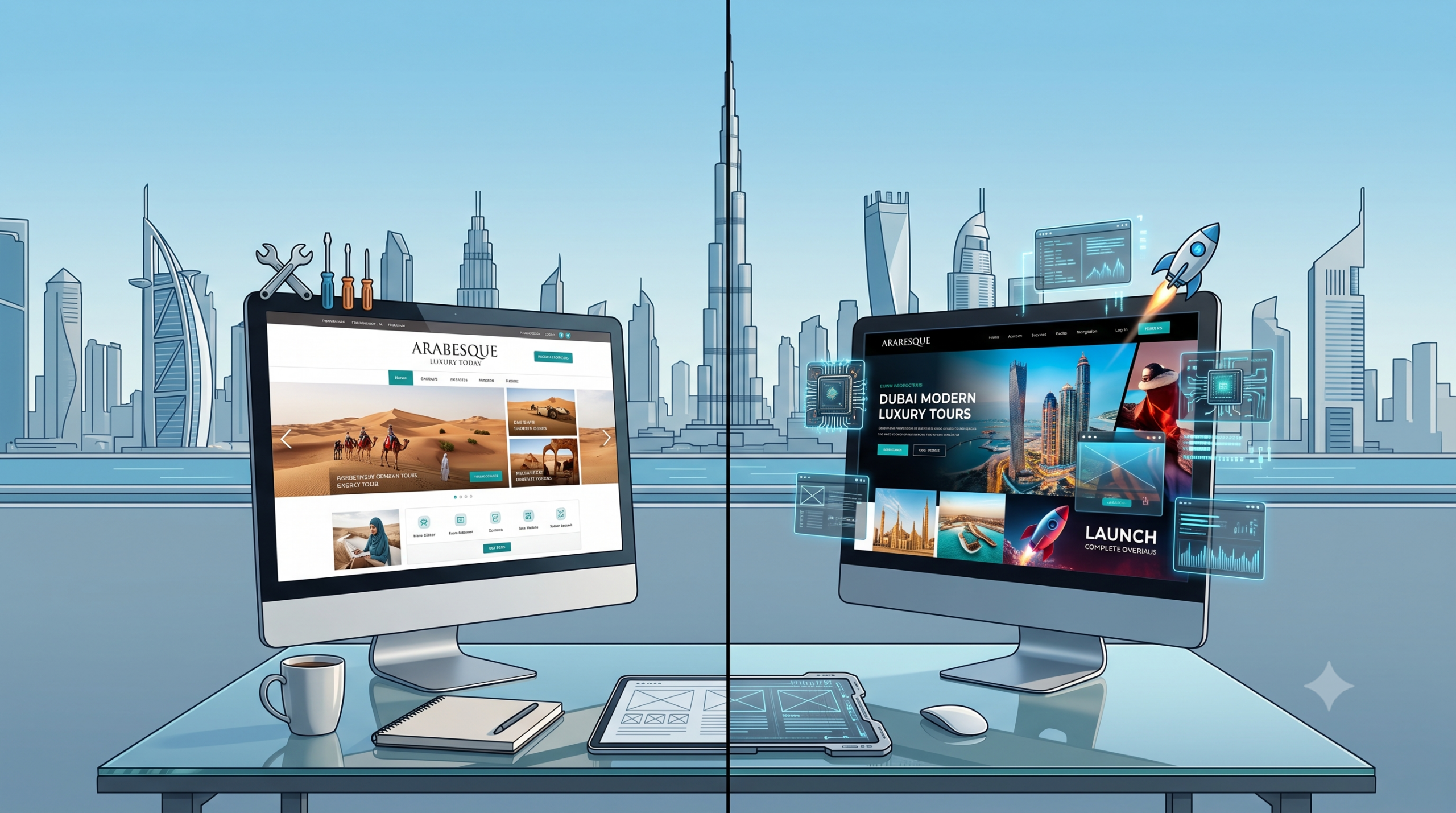
If your website feels dated, isn’t converting, or no longer reflects where your business is headed, you are facing one of the most consequential decisions in digital strategy: do you need a website revamp or a full website redesign? Working with an experienced website revamp agency in Dubai can make this decision far less overwhelming because the right partner will diagnose the actual problem before recommending a solution.
The two main options that might sound similar but can lead to very different budgets, timelines, and business outcomes. A revamp refreshes what is already working. A redesign rebuilds what is not. To choose wrong means wasted spend, missed opportunities, or a project that can never solve the underlying issues.
Through this blog, we will be breaking down both approaches in detail, including cost, timeline, SEO impact, UX, branding, and ROI, so Dubai and UAE business owners can make a confident, informed decision.
What Is a Website Revamp?
A website revamp is a focused refresh of an existing website’s look, content, and performance, all without rebuilding its underlying structure.
Think of it as renovating a house you already like: same foundation, updated interior. Typical revamp work includes:
- Updating branding elements (colors, logos, typography)
- Refreshing the UI and visual design
- Improving photography and imagery
- Updating outdated content and copy
- Enhancing key landing pages
- Adding minor new features
- Improving page speed and performance
A revamp is the right choice when:
- Your CMS still functions well and meets your needs
- Your site’s information architecture is fundamentally sound
- Your business model and offerings haven’t changed significantly
- The brand simply needs visual modernization
Key benefits of a revamp:
- Faster turnaround (often weeks, not months)
- Lower investment than a full rebuild
- Minimal disruption to ongoing marketing and SEO
- Noticeable visual and performance improvements quickly
What Is a Website Redesign?
A website redesign is a ground-up rebuild of a website’s architecture, user experience, and technology, not just its appearance.
This is the equivalent of demolishing and rebuilding, because the existing foundation no longer supports the business. A redesign typically involves:
- New information architecture and site structure
- Complete UX research and redesign
- New UI design system
- Navigation and site-map restructuring
- A new CMS or platform, if required
- SEO restructuring (URLs, taxonomy, internal linking)
- Mobile-first, responsive development
- Conversion rate optimization is built into the structure
- Accessibility improvements
A redesign becomes necessary when:
- Bounce rates are high, and engagement is low
- Conversion rates are underperforming
- The underlying technology is outdated or unsupported
- Site speed and mobile experience are poor
- The business is expanding significantly
- A corporate rebrand is underway
- You’re expanding into new GCC markets and need scalable architecture
Key benefits of a redesign:
- Substantially improved user experience
- Stronger technical and on-page SEO foundation
- Higher conversion potential
- Easier long-term scalability
- Future-ready technology stack
UAE and Dubai-Specific Considerations
Websites built for the UAE market carry expectations that generic global templates rarely meet. A website revamp agency in Dubai with regional experience will factor in:
- English and Arabic bilingual experiences, including proper content parity across both languages
- Right-to-left (RTL) layouts that are designed correctly from the ground up, not bolted on
- Mobile-first experiences, since UAE audiences browse and transact heavily on smartphones
- Fast page speeds are especially important given the region’s competitive, premium digital landscape
- Luxury visual aesthetics that align with Dubai’s brand-conscious consumer base
- Cultural localization, from imagery to tone to seasonal relevance
- GCC audience expectations across Dubai, Abu Dhabi, Sharjah, and neighboring markets
- High-performance, regionally optimized hosting
- AI-powered customer journeys, from chat-based support to personalized content
Given how central mobile browsing is to daily life in the UAE, any revamp or redesign should treat responsive, mobile-first design as a baseline requirement rather than an add-on.
Should You Revamp or Redesign? A Decision Framework
Choosing between a website revamp and a complete redesign does not have to be complicated. The right decision can depend on yoru website’s current performance, technology, branding, and long-term business goals. You can use the following frameworks to assess where your business stands.
If your website is less than two years old and still aligns with your business objectives, a website revamp is often the smarter choice. Minor improvements like updating the visual design, refining content, or optimizing key landing pages can extend the life of your existing website. However, if your website is more than three years old and feels outdated in terms of design, functionality, or user experience, a complete redesign is likely the better investment.
Next, you will need to evaluate your website’s traffic and conversion performance. If your organic traffic remains stable or continues to grow and your conversion rates are healthy but have room for improvement, a revamp can help fine-tune performance without disrupting what is already working. On the other hand, if your website has experienced declining search visibility, high bounce rate, or consistently poor conversion rates, these are strong indicators that a strategic redesign is required to address deeper structural and user experience issues.
Consider your brand identity and technology stack as well. Businesses that simply need a refreshed visual appearance or updated messaging can usually achieve their goals with a revamp. However, if you’re undergoing a full rebrand, repositioning your business, or your website runs on an outdated, unsupported, or insecure CMS, a redesign provides the opportunity to build a stronger digital foundation for future growth.
It’s equally important to assess the mobile experience and marketing requirements. If your website is responsive but could benefit from faster load times, improved layouts, or minor usability enhancements, a revamp is generally sufficient. But if your mobile experience is inconsistent, difficult to navigate, or fails to meet modern user expectations, a redesign is essential. Similarly, businesses refreshing existing marketing campaigns may only need targeted website improvements, whereas launching a new go-to-market strategy or digital transformation initiative often calls for a complete redesign.
Finally, think about your future business plans. If your company is continuing with the same products, services, and target markets, a website revamp can effectively support your ongoing growth. However, if you’re expanding into new GCC markets, introducing new product lines, or significantly evolving your business model, a redesign will provide the flexibility, scalability, and user experience needed to support those ambitions.
How Revamps and Redesigns Impact SEO
Both approaches touch SEO, but in different ways and to different degrees.
- Technical SEO: A revamp typically preserves your existing URL structure and technical setup, reducing the risk to rankings. A redesign often changes URLs, site architecture, and navigation, which requires careful 301 redirect mapping to avoid ranking loss.
- Core Web Vitals: Both approaches can improve loading speed, interactivity, and visual stability, but a redesign offers the opportunity to rebuild performance from the ground up with modern, efficient code.
- Internal linking and crawlability: A redesign is a better opportunity to fix a tangled or shallow internal linking structure and ensure search engines can crawl and understand your site efficiently.
- Structured data and metadata: Both approaches should include updated schema markup and metadata, but a redesign allows for a more systematic, site-wide implementation.
- User engagement and organic rankings: Because engagement signals (time on site, bounce rate, pages per session) influence how search engines evaluate content quality, improvements in either area, when done correctly, tend to support organic performance over time.
The key risk in either case is a poorly planned migration. This is where working with an experienced agency matters most: protecting the SEO equity you’ve already built while improving what wasn’t working.
The Branding Perspective: Why Your Website Is a Brand Asset
A website isn’t just a digital brochure; it’s often the first, and most scrutinized, touchpoint a customer has with your brand. As a branding-led digital agency, Moonbox approaches every revamp and redesign with brand strategy at the center, because a website directly shapes:
- Brand perception: the first impression a visitor forms in seconds
- Customer trust: signaled through design quality, clarity, and professionalism
- Storytelling: how effectively your brand’s narrative comes through in structure and content
- Emotional connection: the difference between a functional site and a memorable one
- Premium positioning: especially critical for luxury, hospitality, and real estate brands in Dubai
- Competitive differentiation: standing out in a crowded, design-conscious market
A technically flawless website that doesn’t reflect your brand identity will still underperform. This is why the strongest revamps and redesigns are treated as branding projects first and technical projects second.
Making the Right Call for Your Business
There’s no universal answer to “revamp or redesign”; the right choice depends on your website’s age, performance, technology, and where your business is headed. A revamp makes sense when the foundation is solid, and you need a faster, lighter-touch improvement. A redesign makes sense when the underlying structure is holding your business back, and you need to rebuild for growth.
What matters most is getting an honest, experienced assessment before committing budget in either direction. As a website revamp agency in Dubai working with SMEs, enterprises, and premium brands across real estate, hospitality, healthcare, and retail, Moonbox starts every engagement with a clear diagnosis rather than a predetermined solution.
If you’re weighing a website revamp or redesign for your Dubai or UAE business, Moonbox can help you evaluate where your site stands today and map out the most cost-effective path forward, whether that’s a focused revamp, a complete redesign, or a phased combination of both. Reach out to Moonbox for a website strategy consultation and get a clear, honest recommendation built around your business goals, not a one-size-fits-all package.
FAQs
- What is the difference between a website revamp and a website redesign?
A website revamp improves an existing website’s appearance, content, and performance without changing its core structure — think updated visuals, refreshed content, and performance fixes. A website redesign rebuilds the site from the ground up, including its information architecture, UX, CMS, and technical foundation. Revamps suit businesses with a solid site that needs modernizing, while redesigns suit businesses whose current site actively limits growth, conversions, or scalability. The right choice depends on your site’s age, performance, and your broader business goals.
- How do I know if my website needs a redesign?
Signs you need a redesign include declining organic traffic, high bounce rates, low conversion rates, an outdated or unsupported CMS, poor mobile usability, and slow page speeds that basic optimization can’t fix. A redesign is also warranted during a corporate rebrand, major business expansion, or entry into new GCC markets, where your current site’s structure can’t support new goals. If your website was built more than three to four years ago and hasn’t kept pace with your business, a redesign audit is a sensible next step.
- How much does a website revamp cost in Dubai?
Website revamp costs in Dubai vary based on scope — the number of pages updated, the depth of design changes, and any added features. Because a revamp works within your existing structure rather than rebuilding it, it’s generally more affordable than a full redesign and delivers results faster. Exact pricing depends on your current site’s condition and your specific goals, so most agencies, including Moonbox, provide a scoped quote after an initial audit rather than a flat rate.
- Does redesigning a website improve SEO?
A well-executed redesign can meaningfully improve SEO by fixing technical issues, improving Core Web Vitals, restructuring internal linking, and modernizing metadata and schema. However, redesigns also carry risk: changing URLs and site architecture without careful 301 redirect planning can cause temporary or lasting ranking losses. The SEO outcome depends entirely on execution; a redesign built with an SEO strategy from the start tends to outperform the original site over time.
- How long does a website redesign take?
A full website redesign typically takes several months, depending on the site’s size, complexity, and the extent of new features or CMS changes involved. This includes discovery, UX research, design, development, content migration, and testing before launch. A website revamp, by comparison, is usually completed in a matter of weeks since it works within the existing structure rather than rebuilding it.
- Which is better for my business: a revamp or a redesign?
There’s no single right answer; it depends on your website’s current performance, technology, and your business trajectory. If your site is relatively recent, technically sound, and simply needs a visual and content refresh, a revamp is the more efficient choice. If your site is outdated or underperforming, or your business is undergoing significant change, such as a rebrand or market expansion, a redesign will provide a stronger long-term foundation. A professional audit is the most reliable way to determine which path fits your specific situation.